Four Pillars of Innovation
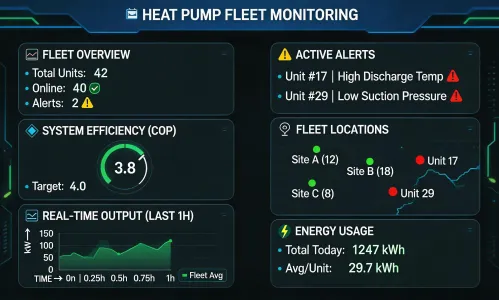
IoT Fleet Intelligence
Every ThermaVerde heat pump ships with embedded sensors monitoring 24 operating parameters in real time — compressor discharge pressure, suction superheat, refrigerant charge status, inverter frequency, and energy consumption. Data streams to our cloud analytics platform where machine learning models detect performance degradation patterns weeks before they trigger alarms.
- 24 sensor points per unit, 15-second data resolution
- Cloud-based analytics with role-based access
- Automated anomaly detection reduces unplanned downtime by 40%
- REST API for integration with third-party BMS platforms
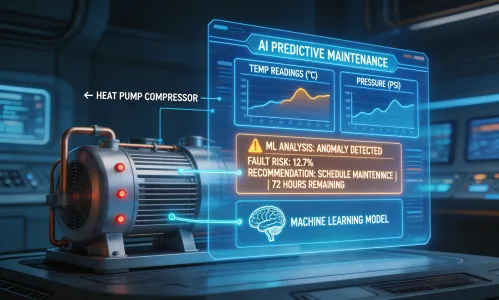
AI-Driven Predictive Maintenance
Our proprietary diagnostic algorithms analyze compressor vibration signatures, heat exchanger fouling trends, and refrigerant cycle thermodynamics to predict component failures before they occur. The system learns from fleet-wide operating data across 48 countries, building increasingly accurate failure prediction models.
- Compressor bearing wear prediction: 6-week advance warning
- Heat exchanger fouling detection: COP deviation threshold of 3%
- Refrigerant micro-leak identification via charge trending
- Fleet-wide learning from 6,500+ deployed systems
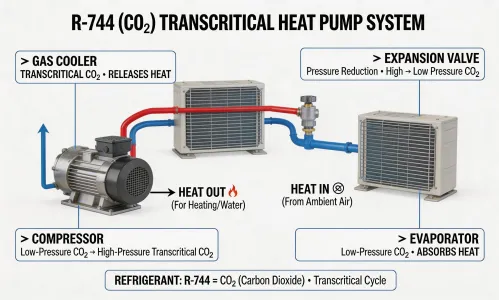
Next-Generation Refrigerant Platforms
ThermaVerde is at the forefront of the global transition from high-GWP HFC refrigerants to natural and ultra-low-GWP alternatives. Our R-290 (propane, GWP 3) platform covers capacities up to 500 kW with enhanced safety features including gas detection, automatic isolation, and reduced-charge circuit design. Our R-744 (CO2, GWP 1) transcritical platform delivers hot water up to 90 degrees Celsius in a single stage.
- R-290 platform: up to 500 kW with EN 378 safety compliance
- R-744 transcritical: hot water to 90 degrees Celsius, COP 3.0+
- R-1234ze cascade: 120 degrees Celsius process heat output
- Full EU F-Gas and Kigali Amendment compliance

Smart Grid & Renewable Integration
ThermaVerde heat pumps are designed as grid-responsive assets. Our control firmware supports demand-response protocols (OpenADR 2.0b), enabling heat pumps to modulate capacity based on grid signals, time-of-use tariffs, and on-site renewable generation. Thermal storage integration extends flexibility, allowing heat pumps to pre-charge thermal mass during low-cost energy windows.
- OpenADR 2.0b demand-response compatibility
- PV surplus detection and automatic load shifting
- Thermal storage tank integration protocols
- Real-time energy cost optimization algorithms